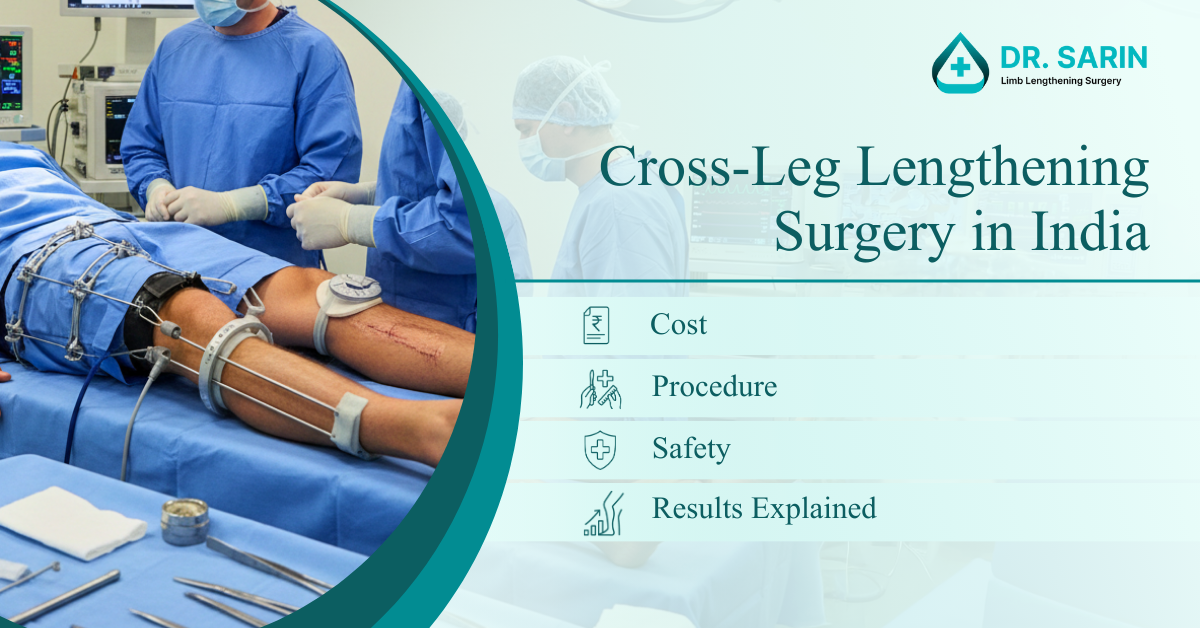
Limb lengthening surgery has evolved significantly over the last two decades. One of the most advanced and reliable methods used today in India is the Cross-Leg Lengthening Technique – a hybrid approach that offers a safer path for patients who want height gain or correction of limb deformities without relying entirely on internal devices.
This method, performed by expert centres like Dr. Amar Sarin’s, combines the stability of external fixation with the precision of internal rods, giving patients faster recovery, better bone healing, and reduced complications.
If you are considering limb lengthening but are confused between Precice, Ilizarov, and hybrid approaches, this guide will help you understand where Cross-Lengthening fits.
What Is Cross-Leg Lengthening?
Cross-Lengthening is a hybrid limb lengthening technique that uses:
- An external fixator (for alignment & stability)
- An internal nail or rod (for long-term strength & early weight-bearing)
The hybrid structure allows the bone to lengthen gradually using the external fixator while the internal rod maintains alignment and protects the bone during healing.
This method is particularly useful for:
- Patients wanting moderate height gain
- Patients seeking straighter legs + height gain
- Complex deformity correction
- People with lower budgets compared to Precice
- Those who want faster recovery than traditional Ilizarov
Why Is It Called the “Cross-Leg” Technique?
The name comes from the cross-support mechanism:
- The external fixator supports the bone from outside
- The internal rod supports the bone from inside
Together, they “cross” in function – giving excellent stability during lengthening.
How Does the Cross-Lengthening Procedure Work?
1. Pre-Surgery Planning
Patients undergo:
- X-rays
- Bone density check
- Medical evaluation
- Physiotherapy assessment
The surgeon also evaluates leg proportions to ensure natural, balanced outcomes.
2. Surgery & Bone Cutting (Osteotomy)
A controlled cut is made in the bone (either femur or tibia). The external fixator is applied, and the internal rod is inserted.
This combination reduces the risk of:
- Severe pain
- Instability
- Misalignment
- Bone collapse
3. Daily Lengthening Phase
After 7-10 days of rest, lengthening begins.
Daily distraction:
- 0.75 mm – 1 mm per day (femur)
- 0.5 mm – 0.75 mm per day (tibia)
The external fixator gradually separates the bone, while the rod keeps it straight.
4. Consolidation Phase
Once the target height is reached:
- The external fixator is removed first
- The internal rod continues to support the bone until full healing
This shortens external fixator time, which is the most stressful part of Ilizarov-only methods.
5. Physiotherapy & Full Recovery
Rehab includes:
- Range of motion exercises
- Strength training
- Ankle & knee flexibility work
- Gait training
Most patients walk comfortably without support in 4-6 months.
Who Is a Good Candidate for Cross-Lengthening?
This technique is ideal for:
- Patients who want 7–8 cm height gain
- Those who want safer, faster recovery than Ilizarov-only
- People looking for a more affordable option than Precice
- Patients with bow legs, knock knees, or other deformities
- Individuals with mild osteoporosis or weak bone structure
(the internal rod offers added support)
Cross-lengthening is commonly recommended when surgeons want a balance between:
- Safety
- Affordability
- Stability
- Faster recovery
How Much Height Can Cross-Lengthening Add?
- Femur Cross-Lengthening: 6–8 cm
- Tibia Cross-Lengthening: 5–6 cm
In experienced hands (like Dr. Sarin’s), tibia can sometimes reach 7–8 cm, but only with excellent physiotherapy and patient compliance.
Advantages of Cross-Lengthening Surgery
1. Shorter External Fixator Time
Traditional Ilizarov requires 7–12 months of frame use.
Cross-lengthening reduces this significantly because the internal rod carries the load after removal.
2. Better Bone Alignment & Lower Risk of Deformity
The internal rod:
- Prevents angulation
- Reduces valgus/varus drift
- Protects against bowing during lengthening
3. Faster Rehabilitation
Patients often:
- Start walking with support earlier
- Maintain better knee/ankle motion
- Experience fewer contractures
4. Higher Safety for Complex Cases
Patients with:
- Bow legs
- Knock knees
- Non-union
- Dwarfism
- Congenital deformities
benefit greatly from the stability of the hybrid system.
Disadvantages of Cross-Lengthening
- Involves external fixator (though for less time)
- More visible scars than Precice
- Slightly more discomfort due to frame
- Risk of pin site infection (manageable with cleaning)
- Slower than full internal Precice method
Despite these, most patients choose cross-lengthening because it offers the best balance of price, safety, and outcomes.
Cross-Lengthening vs Precice vs Ilizarov
| Feature | Cross-Lengthening | Precice | Ilizarov Only |
| Comfort | Moderate | Very high | Low |
| External Fixator | Yes (short duration) | No | Yes (long duration) |
| Scarring | Moderate | Minimal | High |
| Safety | High | Very high | Moderate |
| Height Gain | 6–8 cm | 6–8 cm | 5–7 cm |
| Rehab Difficulty | Moderate | Low | High |
Recovery Timeline
| Stage | Time |
| Lengthening Phase | 2–3 months |
| External Fixator Removal | After height target |
| Walk With Support | 2–3 months |
| Walk Without Support | 4–6 months |
| Full Healing | 9–12 months |
| Return to Sports | 12–15 months |
Natural-looking gait typically returns with physiotherapy.
Common Complications (and How They’re Prevented)
- Muscle Tightness: Regular stretching + daily physio guidance
- Pin Site Infection: Daily cleaning + early antibiotics
- Knee stiffness: Continuous range-of-motion work
- Ankle tightness: Especially in tibia lengthening – managed with dedicated Achilles stretching
With proper rehab, most issues are reversible.
Is Cross-Lengthening Safe?
Yes – in experienced hands, it is extremely safe.
Why?
- External fixator gives precise control
- Internal rod prevents deformity
- Combination reduces risk of complications seen in Ilizarov-only methods
- Earlier walking prevents muscle weakness
This hybrid technique is especially trusted for patients traveling internationally for surgery.
Why Choose Cross-Lengthening at Dr. Sarin’s Centre?
- 30+ years of limb reconstruction experience
- 3000+ successful Ilizarov & lengthening surgeries
- First Indian surgeon to perform live Ilizarov surgery
- Team specialized in deformity correction + height gain
- Dedicated rehab center in Gurugram
- Transparent pricing with no hidden charges
- Treated 1000+ international patients
Cross-lengthening at this center is backed by some of the highest success rates in India.
Conclusion: Is Cross-Leg Lengthening Right for You?
Cross-Lengthening is an excellent choice for patients who want:
- 6–8 cm height gain
- Safer recovery than Ilizarov
- More affordable option than Precice
- Better bone alignment and fewer complications
- Reliable, proven results
It offers the best middle-ground technique for height increase: not as costly as Precice, not as uncomfortable as classic Ilizarov, but combining the strengths of both.
For long-term safety, balanced proportions, and predictable outcomes, cross-lengthening is one of the most trusted methods in India today.
You May Also Like to Know: