
Many people with knock knees wonder whether treatment is actually necessary. Some individuals have lived with the condition for years without giving it much thought, while parents may be unsure whether their child’s leg alignment requires attention.
Because knock knees can vary significantly in severity, there is no single answer that applies to everyone. In some cases, the condition may
represent a mild variation in alignment, while in others it may involve a more significant deformity affecting the position of the lower limbs.
This often leads to an important question: What happens if knock knees are left untreated?
The answer depends on factors such as age, the severity of the deformity, skeletal development, and the underlying cause of the condition. Understanding these factors can help individuals make informed decisions about their orthopedic health.
Understanding Knock Knees
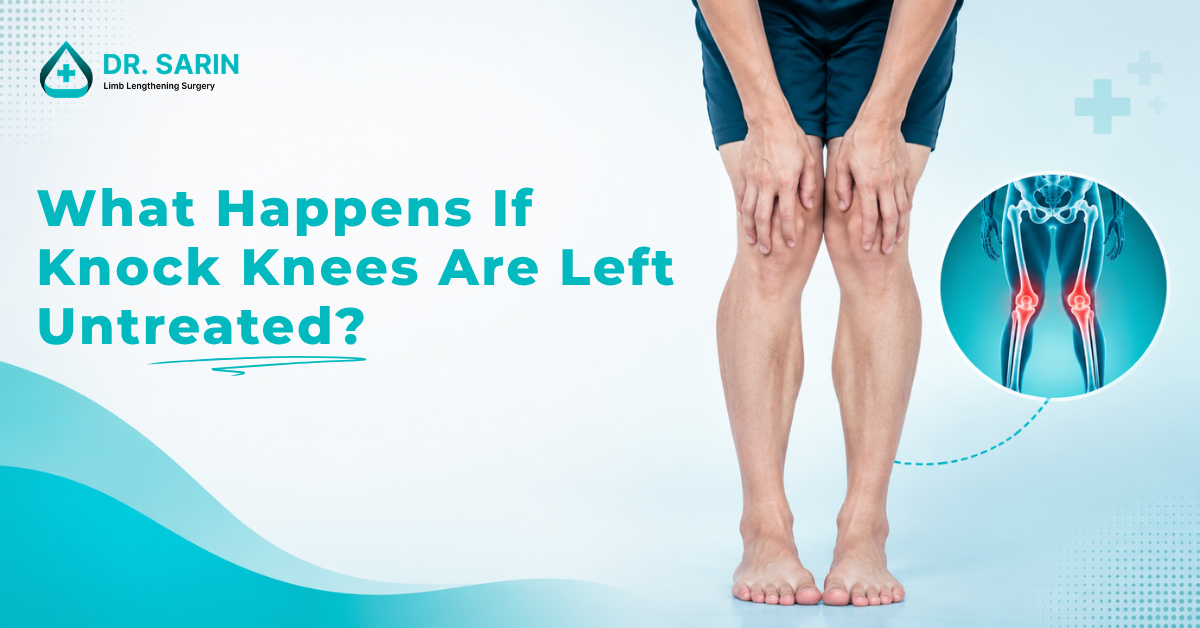
Knock knees, medically known as genu valgum, is a condition in which the knees angle inward while the ankles remain apart when standing.
The condition affects the alignment of the lower limbs and changes the relationship between the hips, knees, and ankles. While some people have only a mild inward angulation, others may have a more pronounced deformity
Because genu valgum exists on a spectrum, the potential consequences of leaving it untreated can also vary considerably.
Are All Cases of Knock Knees a Cause for Concern?
No.
Not every case of knock knees requires treatment.
In many children, changes in leg alignment occur as part of normal growth and development. Some cases may improve naturally as the skeleton matures.
Similarly, some adults have mild genu valgum that causes little concern and remains stable throughout life.
The key point is that the effects of untreated knock knees depend largely on the severity and nature of the deformity.
This is why proper evaluation is so important.
Can Knock Knees Become More Noticeable Over Time?
In some individuals, the appearance of knock knees may remain relatively stable.
In others, the alignment difference may become more noticeable over time. This can occur due to changes in skeletal structure, body mechanics, posture, or overall lower limb alignment.
Because every person’s situation is unique, it is difficult to predict how the condition will change without a detailed assessment.
Monitoring the alignment over time often provides valuable insight into whether the condition is remaining stable or progressing.
How Does Alignment Affect the Lower Limbs?
The hips, knees, and ankles function as part of a connected mechanical system.
When the alignment of one part of the leg changes, it can influence the position and function of other structures throughout the lower limb.
Knock knees alter the way the legs align during standing and movement. The degree to which this affects overall mechanics depends on the severity of the deformity and the individual’s anatomy.
Understanding these alignment relationships is one reason why orthopedic specialists carefully analyze the entire lower limb rather than focusing only on the knees.
Can Untreated Knock Knees Affect Walking?
Some individuals with knock knees notice no significant difference in the way they walk.
Others may become more aware of their walking pattern, posture, or leg positioning over time.
The impact on movement varies considerably from person to person. Factors such as the degree of genu valgum, muscle strength, flexibility, and overall lower limb mechanics all play a role.
A detailed evaluation can help determine whether the alignment is influencing movement patterns.
Can the Effects Be Different in Children and Adults?
Yes.
Children still have growing bones, which means their alignment may change as development continues. In some cases, genu valgum improves naturally during growth.
Adults, however, have reached skeletal maturity. Once growth is complete, significant changes in alignment are less likely to occur naturally.
For this reason, the long-term implications of untreated knock knees may differ between children and adults.
Understanding the patient’s age and stage of skeletal development is an important part of evaluating the condition.
Why Some People Delay Evaluation
Many individuals postpone evaluation because:
- The condition does not cause immediate concerns.
- They assume it is only cosmetic.
- They believe it will improve on its own.
- They are unsure about treatment options.
While these concerns are understandable, delaying assessment may also mean missing an opportunity to better understand the true nature of the deformity.
A professional evaluation does not automatically mean treatment is required. Instead, it provides clarity regarding the severity of the condition and the available options.
Why Self-Assessment Has Limitations
The internet contains countless articles, videos, and photographs related to knock knees.
While this information can be helpful, it cannot accurately determine:
- The degree of deformity
- The source of the alignment issue
- Whether the condition is stable
- Whether treatment may be beneficial
Two individuals with similar-looking legs may have very different underlying alignment patterns.
This is why professional assessment remains the most reliable way to understand the condition.
When Should You Consider an Evaluation?
An orthopedic evaluation may be worth considering if:
- The knock knees appear to be becoming more noticeable.
- One leg looks different from the other.
- You are uncertain about the severity of the condition.
- The alignment has persisted for many years.
- You want a clearer understanding of your treatment options.
These situations do not necessarily indicate a serious problem, but they often justify a closer look at the alignment.
Expert Insight from Dr. Amar Sarin
According to Dr. Amar Sarin, an orthopedic surgeon specializing in limb deformity correction, the effects of untreated knock knees depend largely on the degree of deformity and the individual’s overall lower limb alignment. While some cases may require little intervention, others benefit from a detailed assessment to understand the nature of the condition and its potential long-term implications. Accurate diagnosis and alignment analysis help patients make informed decisions about their orthopedic care and avoid relying on assumptions based solely on appearance.
Conclusion: What Happens If Knock Knees Are Left Untreated?
What happens if knock knees are left untreated depends on the individual case. Some people experience little change over time, while others may notice that the alignment becomes more pronounced or affects overall lower limb mechanics.
Because genu valgum varies widely in severity and presentation, there is no universal answer that applies to everyone. The most reliable way to understand the potential implications of untreated knock knees is through a comprehensive orthopedic evaluation. Understanding the condition accurately allows patients to make informed decisions and determine whether any intervention may be appropriate.