One of the most common questions patients ask before undergoing knock knees surgery is, “How long will recovery take?” While understanding the procedure itself is important, knowing what happens afterward is equally valuable.
Recovery is a critical part of the treatment journey. The success of knock knees surgery depends not only on the correction achieved during the procedure but also on proper healing, rehabilitation, and follow-up care.
Because every patient is different, recovery timelines can vary. Factors such as age, overall health, the severity of the deformity, and the type of correction performed all play a role in the recovery process.
Why Recovery Matters
Knock knees surgery is designed to improve lower limb alignment by correcting the underlying deformity. However, the body needs time to adapt to these changes.
Recovery allows:
- Bones to heal properly
- Soft tissues to adjust to the new alignment
- Strength and mobility to improve
- Normal daily activities to gradually resume
A carefully planned recovery process helps support the best possible outcome.
Is Recovery the Same for Every Patient?
No.
One of the biggest misconceptions about knock knees surgery is that recovery follows the same timeline for everyone.
In reality, recovery depends on several factors, including:
- The patient’s age
- Bone quality
- Overall health
- Degree of correction required
- Surgical technique used
- Commitment to rehabilitation
This is why comparing recovery experiences online can sometimes be misleading.
Two patients with seemingly similar deformities may have very different recovery journeys.
The Early Recovery Period
The initial phase of recovery focuses on healing and protecting the surgical correction.
During this period, patients are closely monitored by their orthopedic team. Follow-up appointments help ensure that healing is progressing as expected and allow the surgeon to assess recovery milestones.
Patients are typically provided with specific instructions regarding mobility, weight-bearing, and activity levels.
Following these instructions carefully is one of the most important aspects of a successful recovery.
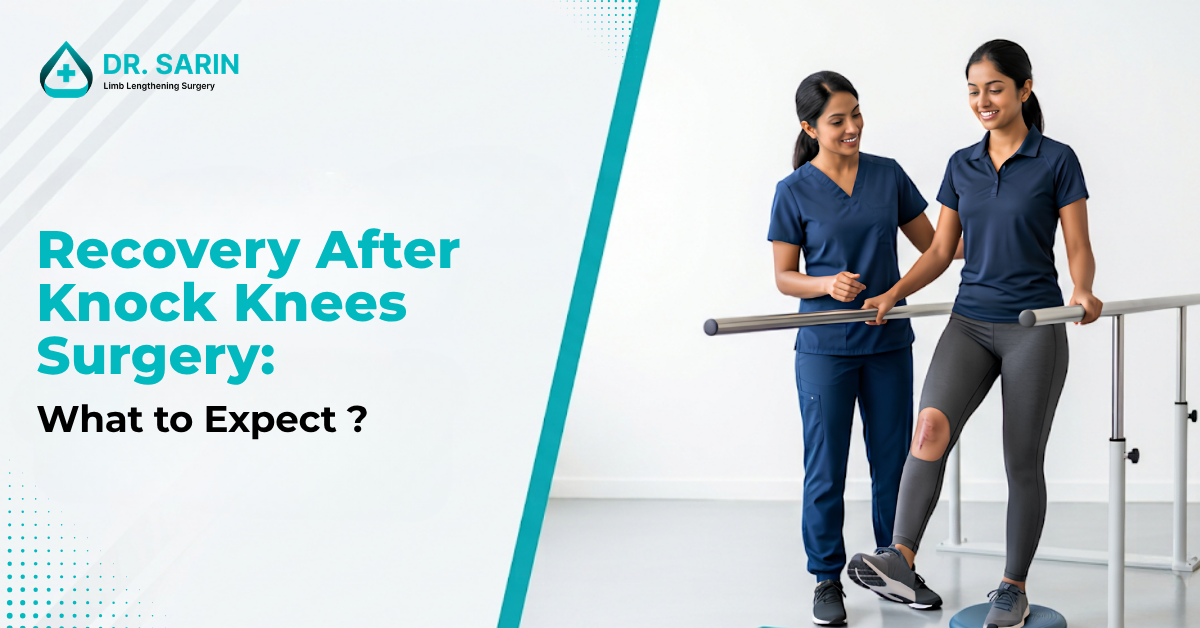
The Role of Physiotherapy
Rehabilitation is often an important part of recovery after knock knees surgery.
Physiotherapy may help patients:
- Improve mobility
- Regain muscle strength
- Restore flexibility
- Improve balance and coordination
- Adapt to the corrected alignment
Because the body has spent years functioning with a particular alignment pattern, it often requires time and guided rehabilitation to adjust to the new mechanics.
A structured physiotherapy program can play a significant role in supporting this transition.
When Can Patients Start Walking?
One of the first concerns most patients have is when they will be able to walk comfortably again.
The answer varies depending on the type of procedure performed and the individual’s healing progress.
Some patients begin walking with assistance during the early stages of recovery, while others may require a different rehabilitation schedule.
The most important point is that mobility progression should always follow the recommendations of the treating surgeon.
Attempting to advance too quickly can interfere with proper healing.
Returning to Daily Activities
Many patients want to know when they can return to normal life.
Activities such as:
- Office work
- Driving
- Household tasks
- Social activities
are typically resumed gradually as recovery progresses.
The timing depends on the individual’s healing, mobility, and overall comfort level.
Rather than focusing on a specific number of weeks, it is more helpful to understand that recovery occurs in stages, with each patient progressing at a different pace.
When Do Final Results Become Visible?
Knock knees surgery creates structural changes in leg alignment, but the final outcome is not always immediately apparent.
As healing progresses and the body adapts to the corrected alignment, patients gradually gain a clearer understanding of the final result.
Factors such as swelling, muscle adaptation, and bone healing can influence how quickly improvements become visible.
Patience is often an important part of the recovery journey.
Why Follow-Up Appointments Are Important
Recovery does not end when a patient leaves the hospital.
Regular follow-up appointments allow the orthopedic surgeon to monitor healing and ensure that recovery remains on track.
These visits help assess:
- Bone healing
- Alignment correction
- Mobility progress
- Rehabilitation goals
Patients who maintain regular follow-up care often gain a better understanding of their recovery progress and receive timely guidance when needed.
Common Recovery Mistakes Patients Make
Some patients unintentionally slow their recovery by:
- Ignoring rehabilitation instructions
- Comparing their progress to others
- Returning to activities too quickly
- Missing follow-up appointments
- Attempting self-directed recovery without professional guidance
Recovery after deformity correction is highly individualized. Following expert recommendations is usually the safest and most effective approach.
Why Choosing the Right Surgeon Matters
Many patients focus primarily on the surgery itself and give less attention to recovery planning.
However, recovery is closely linked to the quality of surgical planning, alignment analysis, and post-operative care.
An experienced deformity correction specialist not only performs the procedure but also guides the patient through the recovery process, monitors healing, and helps address challenges that may arise along the way.
This comprehensive approach often plays a major role in achieving successful outcomes.
Expert Insight from Dr. Amar Sarin
Recovery after knock knees surgery is a carefully monitored process that extends beyond the operating room. According to Dr. Amar Sarin, an orthopedic surgeon specializing in limb deformity correction, successful outcomes depend on a combination of precise surgical planning, proper correction, rehabilitation, and consistent follow-up care. Every patient heals at a different pace, which is why individualized recovery plans are essential. Regular assessment throughout the healing process helps ensure that recovery progresses safely and effectively.
Conclusion: Recovery After Knock Knees Surgery
Recovery after knock knees surgery is an important phase that allows the body to heal, adapt, and benefit from the corrected alignment.
While recovery timelines vary from person to person, proper rehabilitation, follow-up care, and adherence to medical guidance all contribute to a successful outcome.
Patients considering surgery should understand that recovery is not simply a waiting period—it is an active process that requires commitment and expert supervision. Consulting an experienced deformity correction specialist can help patients gain a realistic understanding of what to expect and how to prepare for the recovery journey ahead.