The alignment of the legs plays an important role in the overall appearance and function of the lower limbs. While most people are familiar with the terms “knock knees” and “bow legs,” many are unsure about the difference between these two conditions.
At first glance, both conditions involve changes in leg alignment. However, they affect the legs in opposite ways. Understanding the difference between knock knees and bow legs can help individuals recognize their condition and better understand how lower limb alignment varies from person to person.
What Are Knock Knees?
Knock knees, medically known as genu valgum, is a condition in which the knees angle inward toward each other when standing.
In a person with knock knees, the knees may touch or come close together while the ankles remain apart. This creates an inward alignment of the legs that is visible when standing upright.
The degree of inward angulation can vary from mild to more noticeable. Some individuals have only a slight alignment difference, while others have a more pronounced appearance.
What Are Bow Legs?
Bow legs, medically known as genu varum, is the opposite of knock knees.
In a person with bow legs, the knees remain apart when standing with the feet and ankles together. Instead of angling inward, the legs curve outward, creating a bow-like appearance.
Like knock knees, bow legs can range from mild to severe. The condition affects the alignment of the lower limbs and changes the overall appearance of the legs.
The Main Difference Between Knock Knees and Bow Legs
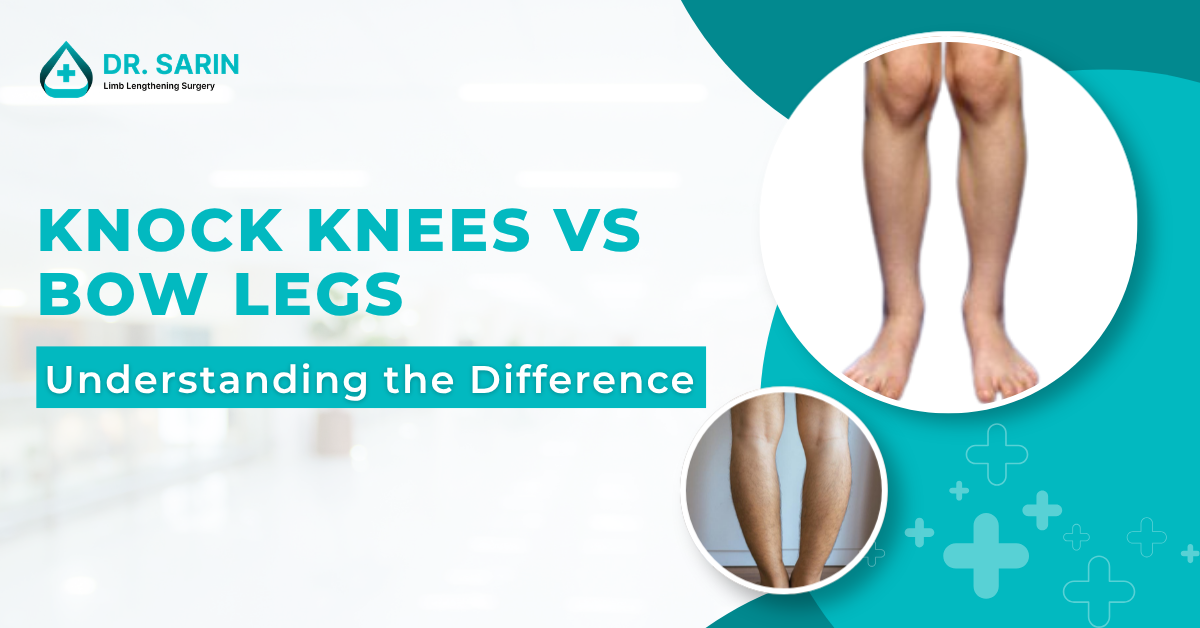
The easiest way to understand the difference is to look at the position of the knees and ankles while standing.
With knock knees, the knees move inward toward each other while the ankles remain separated.
With bow legs, the ankles may come together while the knees remain apart.
In simple terms:
- Knock knees create an inward angle at the knees.
- Bow legs create an outward curve of the legs.
Because the alignment changes occur in opposite directions, the appearance of the two conditions is very different.
How Do Knock Knees Look?
When a person with knock knees stands naturally:
- The knees touch or nearly touch.
- A gap remains between the ankles.
- The lower legs angle outward below the knees.
- The legs appear to form an inward alignment.
The condition is often easiest to notice when standing with the legs straight and facing forward.
How Do Bow Legs Look?
When a person with bow legs stands naturally:
- The ankles may be close together.
- A gap remains between the knees.
- The legs curve outward.
- The lower limbs form a bow-shaped appearance.
This outward curvature is the feature that gives bow legs their common name.
Are Both Conditions Related to Leg Alignment?
Yes. Both knock knees and bow legs are considered lower limb alignment variations.
The difference lies in the direction of the alignment change. In genu valgum, the knees move inward. In genu varum, the knees move outward.
Because alignment influences the position of the hips, knees, and ankles, both conditions affect the overall structure of the lower limbs.
Although the appearance differs, both conditions involve the way the bones are positioned relative to one another.
Can Children Have Knock Knees and Bow Legs?
Both conditions can be seen during childhood growth and development.
Children experience several natural changes in leg alignment as they grow. During different stages of development, some degree of bowing or inward angulation may occur as part of normal skeletal growth.
Because growth patterns vary among children, the appearance of the legs can change significantly during the early years of life.
Understanding the difference between knock knees and bow legs helps parents recognize these alignment variations more easily.
Can Adults Have Knock Knees and Bow Legs?
Yes. Both conditions can be present in adults.
Some adults have retained the alignment pattern they developed during childhood, while others may notice alignment changes later in life.
The appearance and severity of both knock knees and bow legs can vary considerably. Some individuals have only a mild difference in alignment, while others have a more noticeable deformity.
Adult cases often require a more detailed understanding of the underlying alignment and bone structure.
Which Condition Is More Common?
There is no simple answer because both knock knees and bow legs can occur at different stages of life.
Certain alignment patterns are commonly seen during childhood development, while others may persist into adulthood. The frequency of each condition can vary depending on age, growth patterns, and individual skeletal characteristics.
Rather than focusing on which condition is more common, it is more important to understand the specific alignment pattern affecting an individual.
Why Is It Important to Know the Difference?
Many people confuse knock knees and bow legs because both involve changes in the appearance of the legs. However, identifying the correct condition is important for understanding lower limb alignment.
Knowing whether the knees angle inward or outward helps individuals describe their concerns more accurately and seek appropriate orthopedic guidance when necessary.
A basic understanding of these conditions also makes it easier to discuss leg alignment, posture, and orthopedic health with a specialist.
Expert Perspective from Dr. Amar Sarin
Although knock knees and bow legs may appear similar to those unfamiliar with orthopedic conditions, they represent opposite types of lower limb alignment. According to Dr. Amar Sarin, an orthopedic surgeon with extensive experience in Bow Leg & Knock Knee Tretment, accurately identifying the nature of the alignment difference is an important step in understanding the condition. A detailed evaluation helps determine the degree of deformity and provides valuable insight into the most appropriate management approach for each individual.
Conclusion: Knock Knees vs Bow Legs
Knock knees and bow legs are two different conditions that affect lower limb alignment in opposite ways. In knock knees, the knees angle inward while the ankles remain apart. In bow legs, the knees remain apart while the legs curve outward.
Understanding the difference between these conditions helps individuals recognize their alignment pattern and become more informed about their orthopedic health. Whether the concern involves inward or outward angulation of the legs, awareness is the first step toward gaining a better understanding of lower limb alignment.